Sunday, March 29, 2015

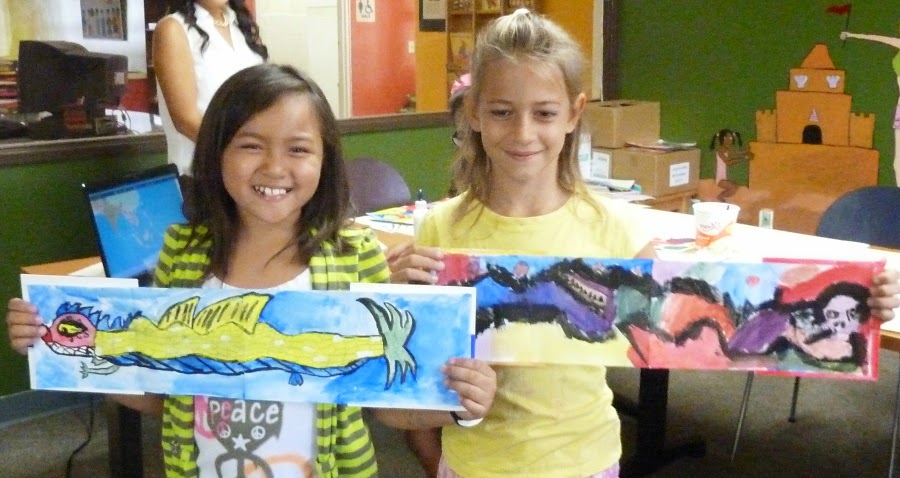
The Big Brothers Big Sisters Art to Go artworks were on display at Whole Foods Maui from August through October 2014, as well as a large painting of my own.

During our opening, a young member of the AKAKU YBEAM came and filmed an excellent video about the project and exhibit.  Watch the video here.


Eric of BBBS, and his wife Genell, who helped hang the show.  (Working with tall ladders, wires, and lots of art as people eat breakfast, and then lunch at Whole Foods is FUN!)

Thursday, March 19, 2015

Kula School Art Show--Approaching Fast!

I'm spending this Spring Break organizing the art that my students, K-5th, created this year in art class.  April 10th, 6pm, at Kula Community Center, will be the show.  I am firing up the kiln, counting artworks, sitting in the community center sketching out how I will arrange the tables and hang the art.  The school used to do an event like this years ago.  Each student had one piece in the show.  I'm aiming for an average of two per student.  I am also coordinating to have students be Art Ambassadors.  They will run tables where people can try out some of the techniques students learned this past year.
I just wish the show would get to be up for more than one night!


21st Century Skills, Technology, and standing Bloom on his Head

This is a video project I did as a part of my coursework for my teaching credential through Teach Now's online project-based program.
Our essential question for this project: How can we use technology to teach 21st Century Skills?
Creativity, Collaboration, Critical Thinking, and Communication are essential parts of learning for the quickly-changing world we live in--and an area of education where I tend to get excited.

This video has two parts.  The first section is a cut-out animation of my philosophy for integrating technology and 21st Century Skills.  From the 1:55 time mark I cover several apps and online tools that could be used to creatively and collaboratively research, collaborate, problem solve, and publish a project, in this case, relating to 4th grade Social Studies curriculum about pre-contact Hawaiian culture.  In re-viewing my project, I feel that, with scaffolding, 4th graders could do it, but that it is very applicable to a middle school environment.  

Thursday, July 3, 2014

Talking Kids and Creativity on Hawaii Public Radio

This morning I talked with Chris Vandercook on Hawaii Public Radio about the importance of encouraging our children's natural creativity.  You can listen to the short conversation by clicking here.


Tuesday, July 1, 2014

Projects from Maui Art Camp

This summer I am posting about the exciting projects of my program, Maui Art Camp over at mauiartcamp.com.  Click Here to see what we've been making.

In case you don't make it over to that site (where there's a full description of the projects and tons of photos), here's a visual taste:


Thursday, May 15, 2014

Maui Art Camp!

The wonderful partnership with Big Brothers Big Sisters has resulted with me bringing back the summer art camp program I ran before traveling in Asia for three years.  Maui Art Camp will take place at the Big Brothers Big Sisters Mentoring Center in Wailuku for five fantastic weeks this summer (map).

There will be five fantastic themes, and classes for children ages 6-8 and ages 9-12.

Visit mauiartcamp.com to register!

Art On the Go--Partnering with Big Brothers Big Sisters and Honolulu Museum of Art


Before even landing back on Maui I had a project.

Art On The Go is an outreach program between Big Brothers Big Sisters and the Honolulu Museum of Art, which had recently been expanded to include Maui.

The plan was to run art classes for the Littles (at-risk kids in elementary school) and Bigs (volunteering high schoolers) during their after school gatherings at various schools around Maui.

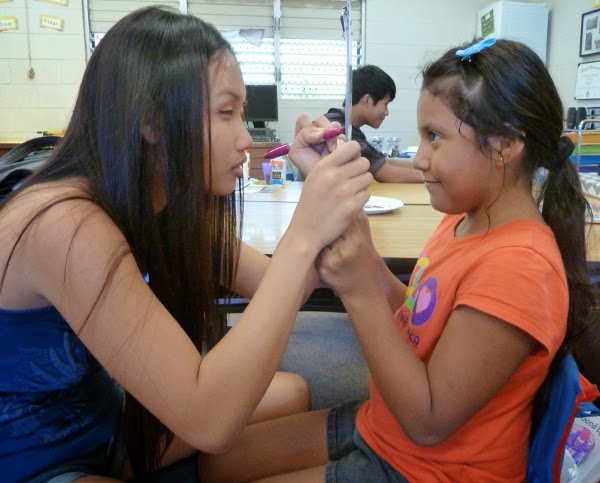
We especially wanted to create projects that encouraged each Big and Little pair to interact and create a closer bond.  The project became mixed media portraits.

Our supplies were: transparency sheets (the kind every office has stashed half-forgotten in some cabinet, leftover from the era of overhead projectors), colored Sharpies, colored paper, oil pastels, and colored masking tape.  We also had scissors, and most importantly, transparent clipboards.

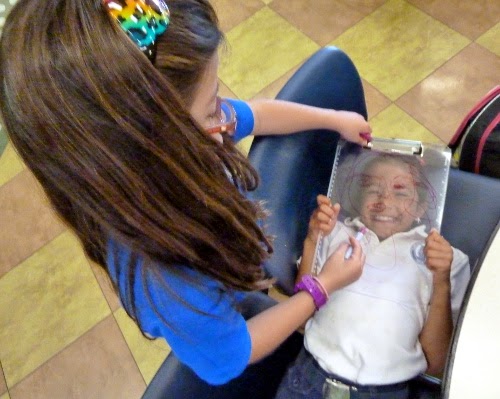
Using the transparency sheets attached to the transparent clipboards, the young artists were able to trace their partner's portrait.

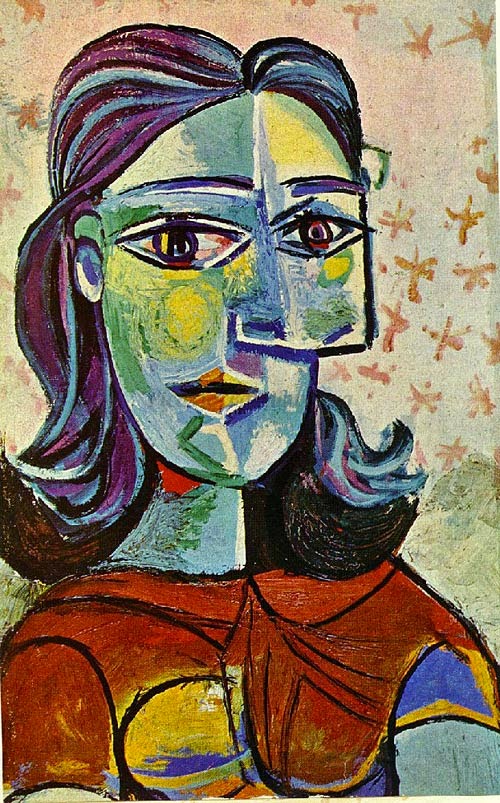
This sounds easier than it is!  If either person moves their head a little bit, the face becomes a Picasso!  So we worked at our cooperation and focus... but if a person's face started to turn abstract, then the artist would make new creative choices to still turn it into a fantastic work of art.  In art, a "mistake" is simply a time when you get to make new choices you weren't expecting.  You get to try a new path and be even more creative!

Another side-effect of tracing your partner's face, is that you can't help but make some very silly faces.  (It's easiest to trace if you close one eye.)

Each artist took a turn drawing the portrait and experimenting with these fun challenges. Once they finished, the Bigs and Littles decide: did they want to continue to color the portrait of their partner that they drew, or color the portrait of their self that their partner drew?  Sometimes they even decided to color both pieces together.  Regardless, each artwork was collaborative to some extent.

 Amazingly, oil pastels work wonderfully on transparency sheets--especially the ones that have a slightly rough film on one side meant for photocopying.  The trick is to color on the opposite side as where you drew with Sharpie.  The Bigs and Littles experimented with blending oil pastels and expressive rather than realistic color.  Once finished, colored paper was placed behind the drawing.

The final touch was a border made out of colored masking tape, which also held all the elements together.  This border often became a project all of its own as the young artists experimented with cutting shapes and making patterns using the tape, as well as coloring the tape with the markers.

Look for these expressive portraits in Whole Foods in Kahului in August--we're taking over their gallery space!


Collaborative coloring at Pukalani Elementary School
The frame pulls it all together! Lahaina students use tape to add patterns.
Completed Masterpieces at Pukalani Elementary.
The Wailuku group at the Big Brothers Big Sisters Mentoring Center
Big and Little artists of Kamehameha Schools, Maui Campus
Princess Nahienaena Littles and Lahainaluna Bigs
talk about their finished portraits.

Kahului Elementary School Littles and Maui High School Bigs
Special Thanks to Rae Takemoto for the clipboards and the key secrets to making this project work!  (i.e. when your partner is drawing you and you are holding the clipboard, lock your elbows to your side so the clipboard doesn't move!)

Sunday, April 20, 2014

Teaching Video: Proportion People Project

"I've never seen them focus that intensely.  They asked if they could do it again the next day."   --Ann Ashley, the students' classroom teacher


Here is a video of me teaching an art lesson this last week at Kula Elementary School in Maui, Hawaii (my old elementary school!)
These 5th graders learned a new way to draw people, one that allows the students to draw people in just about any position they can imagine.  They made use of anatomy, proportion, and measuring using units.  I have taught versions of this lesson to students as young as 2nd graders.  Guided by the questions of these older students, we expanded off the basic lesson to include concepts such as foreshortening and complex poses.

Here are the time marks for interesting moments in the lesson:
00.00   Introduction, student example
2:18     Look at Da Vinci's sketches and talk about anatomy
4:20    What is Proportion?
6:04    What can we use to measure our body? (Students try several ideas.)
8:08    How many heads tall is your body?  (Students measure with partners, we record answers, guesstimate a class average.)
10:14    Drawing demonstration using proportion and simple anatomy.
16.24    Students think about the body position they will draw, stand up and pose.
18:27    One-on-one, answering advanced questions that lead to learning about foreshortening.
20:25    Midway conversation: What can we look for in a gallery walk?
23.54    After the gallery walk: What interesting choices did you see?  Which of your challenges did you find solutions for by looking at classmates work?
At the end of the movie the students return to work and put their ideas from the gallery walk to use. They continued to draw for another 20 minutes. Students fine-tuned body positions, added backgrounds, and shading.  In the last 5 minutes we looked at the completed artwork at a circular table, allowing students to gather around and share about their work.  

What I love about this project:
Between 3rd and 5th grade students begin to look for a way to accurately draw what they see in their mind.  This lesson gives a set of steps that all the students seem to find accessible and useful for drawing people doing things.  (Note: I always state that this is one way to draw people, not the only way.  I want them to feel good about their personal drawing styles, even if I'm asking them to follow certain steps for this project.)
My experience has been that students are excited to use these techniques to express their own experiences, create fictional characters such as superheroes, and to illustrate concepts.  Teachers report back that students continue to use this process without prompting in classwork drawings, as well as to draw in their own free time.  It becomes a tool that enables their creative and academic expression.


This student chose to illustrate a scene from a favorite Animorphs book and include dialog in the drawing.  

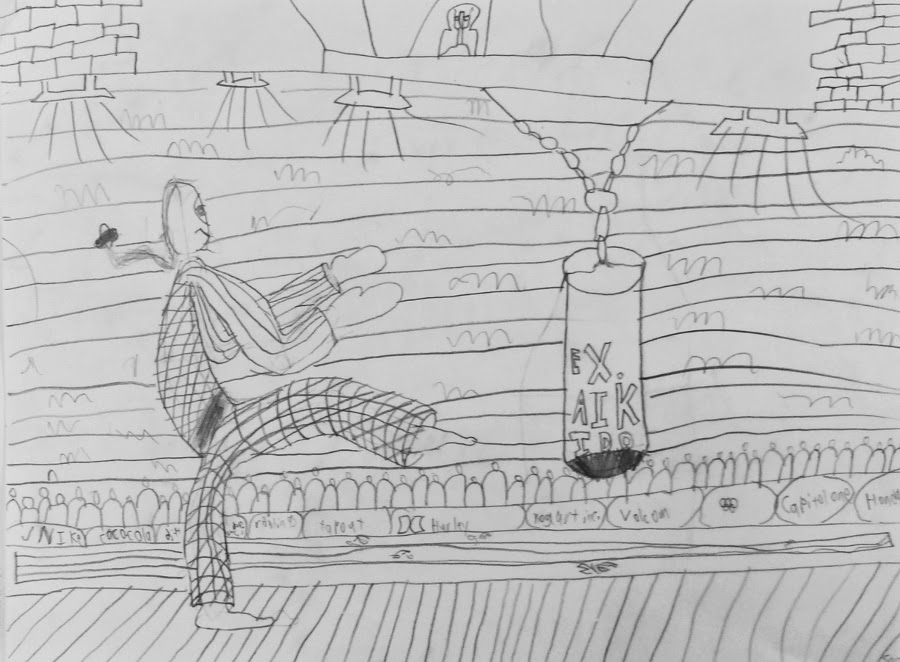
A martial artist performing in front of a crowd

A weightlifter in a gym

Tether ball

Playing baseball in the rain
The student attempted a challenging sideways pose.

Playing soccer, with a fantastic background

Monday, April 7, 2014

To See...

I want my students to learn to see.  

When you learn to draw you help your brain understand that the clip-art image in your head is not the same as the object in front of you.  To observe an object and render it accurately on paper shows careful attention, close observation, and the questioning of prior assumptions.  You put in the time, and in return, you better understand a tiny piece of the world.  

If you put a still-life in the middle of a room and sit all the students around it, no two drawings will be the same.  We all see the world differently, at its very simplest in that no two people can stand in the same place at the same time. Every point of view is true and valuable.  To express your perspective beautifully and clearly is to overcome fear and contribute a piece of yourself to the world.  
Furthermore, sharing yourself is to make yourself vulnerable.  A culture of trust and respect is needed.  When you are open, when you trust, you are also more open to other perspectives.  Art (in its largest, encompassing definition) allows us to stand where others have stood.  Our world grows.

I speak of this in terms of drawing, but this is true in reading a story and sharing your analysis, solving an engineering challenge, writing an essay, discussing history, or discovering alternate ways to solve a math problem.  We need the skills and practice to clearly see and to express our vision.  Furthermore, we need the support and right environment to not only confidently share our visions, but to learn to deeply appreciate the viewpoints of others.

Saturday, April 5, 2014

Deeper Learning: Art and Comfort Zones

During one session on growth vs. fixed mindsets and on how the simple act of having students feel like they belong can greatly improve their academic trajectory, Rob Berger surprised everyone with an activity that put many outside of their comfort zone.  
We were all going to do an art project.  
He asked, "How do you all feel about that?"  
Many people began to murmur and squirm.  
I, in contrast, pulled out the watercolor pallet and pens I keep in my purse.  
He then told us that we were all going to make thank you cards for volunteers that helped make the conference happen.  People felt somewhat better.     


I turned my seat around at my desk and drew the room full of teachers.  These were teachers here to stretch their own minds, who at the moment were stepping outside of their comfort zones in order to express their thankfulness.  I, in contrast, was completely in my comfort zone.  I have been practicing drawing people in crowded, quick circumstances for the past year in Taiwan.

As I drew them, I thought how I needed to find some other way of stepping out.  And as so often happens, we clearly know the name of the thing that makes us feel the most uncomfortable.  For me: math (and not geometry and visually accessible math, but the type you need to comprehend through abstract equations.) 

The next morning, the last day of the conference, I found the session called Achieving Deeper Learning Through Problem-based Tasks in Math, taught by Jeff Heyck-Williams from Two Rivers Public Charter School. 

Math, like art, is a realm that we often have strong associations with from our childhood.  Based on a few early experiences, perhaps a certain teacher, we often have a fixed mindset.  In other words, we think we are either good at it, or we aren't.  I've long known I'm an art person, not a math person--but that is my own mental construction.  

Jeff led us through a way of learning that was intrinsically tied to a word problem.  
"If a hen and a half laid an egg and a half in a day and a half, how long will it take 24 hens to lay 24 eggs?"
We were given the problem before we were given the skills to solve it.  Instead, we were given tools to help us understand the problem.  And though he taught us about ratios and rates along the way, he mostly left us open to puzzle out the problem in our small groups, to present, and argue our answer.  I found it exciting, edge-of-my-seat learning.  (And this despite the fact that I felt I couldn't cram any more in my brain that morning.)  

As educators, we need our own experiences of turning from a fixed mindset to a growth mindset.  I was able to feel that I belonged in that room alongside the math teachers, and that the challenge of engaging my own mind--and the mind of students-- in mathematical thought, was something I could grow through.  Even more-so, I can call upon this experience of practicing a growth mindset for my own teaching, regardless of the subject.